

Skin8 min readAugust 2026
Skin changes.
Your moisturizer should too.
Postmenopause quietly rewrites the skin — thinner, drier, slower to repair. A look at what actually shifts, and why the bottle on your shelf may need to change with it.
Skin keeps a record of the body's seasons. There is the slow, visible accounting of sun and years — and then there is a quieter turning point, less photographed but no less decisive: the decline of estrogen after menopause. It arrives without ceremony, and it changes the skin from the inside out.
Estrogen is not a cosmetic hormone. For decades it quietly directed the skin's infrastructure — signaling fibroblasts to make collagen, instructing glands to produce the lipids that seal moisture in, keeping the barrier taught and the turnover brisk. When its levels fall, that instruction slows. The skin does not merely age. It reorganizes.
“The skin does not merely age after menopause. It reorganizes.”
The changes are measurable. Collagen production drops sharply in the years surrounding menopause — some studies estimate a loss of up to 30% in the first five years alone. The epidermis thins. The lipid mortar between cells loosens, and transepidermal water loss climbs. Skin that once held hydration for hours now feels tight by mid-afternoon, repairs more slowly, and flushes more easily. Dryness becomes structural rather than situational.
Here is the part most moisturizers miss: they were formulated for younger skin's problems. A lightweight gel built to mattify oiliness offers little to a barrier that has gone porous. A heavy occlusive may seal the surface but does nothing to rebuild what has thinned beneath it. The need has changed; the category, largely, has not.
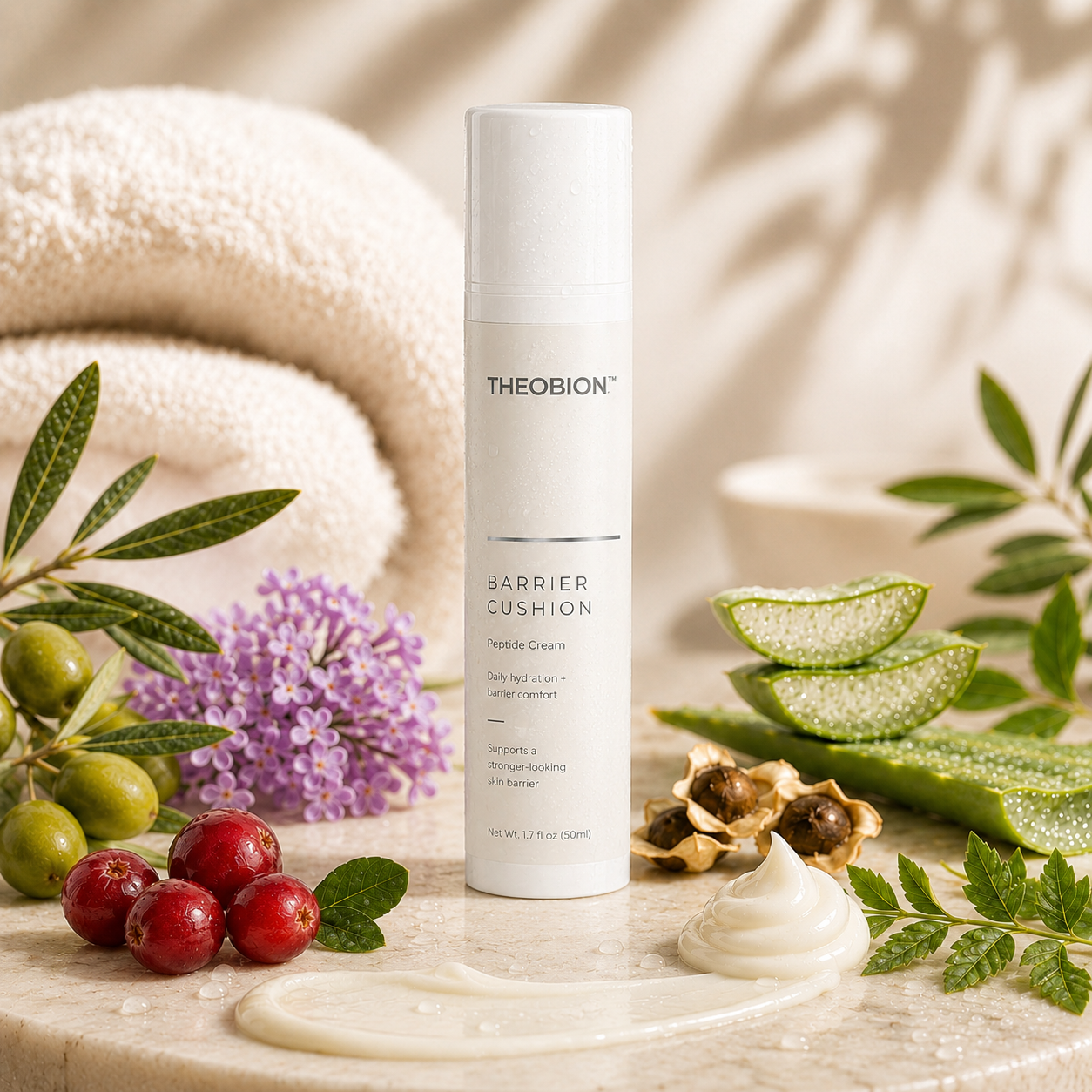
This is the premise behind Theobion Barrier Cushion Peptide Cream — a moisturizer designed not around the skin you had, but around the skin you have now. Rather than masking dryness, it works at the level of the barrier itself, cushioning and reinforcing the structure that holds moisture in.

Featured
Theobion Barrier Cushion Peptide Cream
A barrier-first moisturizer for skin in transition.
The formula's logic is barrier-first. Copper Lysinate and Prolinate — a peptide complex — are there to support the skin's own repair signaling, the kind of instruction estrogen used to give. Glycerin draws water into the deeper layers; aloe and witch hazel water calm the reactivity that thinning skin invites. Cranberry and botanical extracts add antioxidant defense, while the formula stays free of fragrance, parabens, silicones, and sulfates — the common irritants a compromised barrier can no longer easily shrug off.
“A moisturizer designed not around the skin you had, but around the skin you have now.”
None of this is a reversal. Menopause is not a flaw to be corrected, and postmenopausal skin is not a problem to be solved. But it is skin with new needs — and meeting those needs is its own quiet form of care. The right moisturizer does not promise to turn back the clock. It simply changes, as the skin has changed, to meet it where it is.